Showing posts with label Places. Show all posts

Wednesday, April 1, 2026

Parks by the people and for the people

Buffer zone governance committees have made national parks participatory, but not inclusive

Birendra Mahato in Chitwan

Canoe ride on the outskirts of Chitwan National Park.

Dimar Chaudhary was born and raised in Old Padampur, the village inside what is now Chitwan National Park before it was designated a protected area.

His Tharu community, as well as other indigenous groups, traditionally relied on Chitwan’s jungles and rivers for generations. Chaudhary himself had grown up collecting medicinal plants and wild vegetables, gathering wood, and grazing cattle in the forest.

Chitwan, along with much of Nepal’s Tarai, was plagued by malaria until a US-supported DDT spraying campaign to wipe out the disease in the district in the 1950s. This opened the valley up to trans-migration of farmers from the hills. Before that, Chitwan was inhabited entirely by indigenous people: 90% of the district’s population was Tharu, and the rest were Bote, Mushar, Darai and Majhi communities.

In 1973 Chitwan National Park became Nepal's first protected area and in 1996, the Nepal government introduced the Buffer Zone Management Rule under the National Parks and Wildlife Conservation Act to manage forests surrounding protected areas, and ensure local participation in parks management.

Old Padampur was subsequently relocated outside the park. Ntional parks formed buffer zone user committees (BZUCs) to manage and oversee community forests. Hundreds of thousands of local people were directly involved in managing buffer zone community forests across the country.

Over three decades, these forests have not only made conservation collaborative, but also helped to mitigate wildlife-related crimes and human wildlife conflict. In 2014, 2015 and 2016, Nepal achieved zero poaching for its three flagship species: rhinos, tigers and elephants.

But while these user communities have made wildlife conservation participatory, the process hasn’t been inclusive of Nepal’s indigenous and underserved communities. In 2022, WWF supported Community Conservation Nepal to collect data on natural resources used by Tharu indigenous people before the establishment of Chitwan National Park.

The project also looked into the inclusion of indigenous, women, Dalit and disabled communities in the Baghauda, Paachpandav, Meghauli, Mrigakunja, and Amaltari Buffer Zone User Committees (BZUC) as well as the Someshwor, Gardi Chure, Radha Krishna, and Baghmara Buffer Zone Community Forests (BZCF).


Barriers to inclusion

The survey found that women are underrepresented in all the BZUCs despite women user groups being larger. Nepal’s Buffer Zone laws dictate that each BZUC has 13 members. Each BZUC is made up of nine units, and as many representatives are elected from those units. The elected members have the authority to choose the remaining four members. This meant that indigenous peoples, marginalised groups, and women have a far lower chance of being elected.

Indeed, out of the total members, Paachpandav and Mrigakunja BCUZs had four women, Meghauli had three women, and Baghauda had only one woman, whereas Amaltari user committee had no woman member.

In contrast, the BZCF are relatively more inclusive of women, with two out of four surveyed BZCF comprising half women members. Additionally, some grassroots user committees are made up entirely of women.

Most women members of the user committees are not appointed through elections, but chosen by elected male members, and are not given positions of leadership.

“Women have been the ones protecting the forests ever since the concept of forest conservation initially emerged,” one female participant told us during a focus group discussion.

People would get angry when the women stopped them from cutting down trees and grass, and grazing cattle in the jungles, she recalled, adding, “We were dedicated to the user committees. However, we are no longer involved in the committees, nor are we invited to meetings.”

When asked about the absence of women in the user committees, one BZUC chairperson responded, “There are only men here because they won the election. Women are unwilling to run for the election. How will they fit into the committee if no woman has ever run for election?”

However, not only are women deprived of the chance to contest elections, the chances of them winning polls are also very low because a majority of the positions in the committee will already have been allocated by political parties to their male cadres.

Women from marginalised communities face further hurdles.


“No male member from the Musahar community has been elected in the user community, if they had, they could have suggested that women from our community be included in the committee as well,” said a female participant from the Musahar community.

While the native Musahar and Bote people lack representation in the BZUC, indigenous people did make up the majority of the members in the committees, while Dalit members were included in some collectives. However, only one committee is led by an indigenous person. The others are chaired by upper-caste hill migrants. In addition, no committee had any representative with disabilities.

One of the key reasons for the under-representation of marginalised communities in Nepal’s BZUC is its non-inclusive policy. When Nepal’s Constitution was promulgated in 2015, residents living in proximity to protected areas across Nepal had hoped that policies relating to buffer zones and their governance would be reformed to reflect Nepal’s new socio-political reality. But this has not been the case.

However, this has not discouraged indigenous Nepalis, who have continued to demand buffer zone policy reforms that ensure the inclusion of women, indigenous and marginalised communities.

In addition to policy revision, it is necessary to reform the buffer zone election so that it is more participatory for underserved communities. Reforms should also regulate the number of members in a user group.

Similarly, the budget allocated for buffer zones must be used on activities that benefit conservation instead of local infrastructure development. Women, people with disabilities, indigenous and marginalised communities should be the primary beneficiaries of budget dispensation. Crop damage compensation, which currently is Rs10,000, can be increased by five times to Rs50,000.

Policy revisions should ultimately guarantee the rights of indigenous communities like the Sonaha, Bote and Musahar to practice their culture and traditional livelihoods and receive a formal education. Buffer Zone User Committees must apply indigenous conservation practices for park management.

Birendra Mahato is an elected member of the Ratnanagar Municipality Ward 6 and Founder Chair of the Tharu Culture Museum Research Centre in Sauraha.

Republished from the Nepali Times with the author's permission.

Tuesday, March 24, 2026

Park policy and the agony of tribal displacement

Most of the Tharus became landless when they refused to relocate the settlements inside the Chitwan National Park to Thori, their 'refugee life' began in their own sweat-irrigated places, the state is not ready to accept the Tharu community as a stakeholder in the park protection despite suffering too much.

Birendra Mahato

Remnants of Gainda Wildlife Camp operated inside
Chitwan National Park. Photo: Sanjib Chaudhary

Discussions and preparations to generate income by operating a hotel within Chitwan National Park have started again. Even after the establishment of the park, 7 hotels were operated in it for about 30 years. History is a witness of the lack of support in the park's income and conservation due to the operation of those hotels.

What should not be forgotten is that many settlements there were forcibly removed to establish the park. Most of which were settlements of the main tribal Tharu community of Chitwan. 

Any how the tribals are now living outside the park. After the hotels moved out of the park, around 10 five-star and more than 200 hotels are promoting tourism in Chitwan. The argument that a hotel must be kept inside the park for the expansion of tourism has faded from practice.

By displacing the Tharu tribals in the name of establishing a park, what is the contradiction of making a policy in the name of tourism and revenue growth on the ancestral lands of those tribals? If a hotel is to be operated inside the park, the government will first allow the displaced tribals to open a hotel after taking away their land? Definitely not. 

Until 2050 years ago, three families including old Padampur resident Balsingh Chaudhary (father, uncle) had 120 bigha of land inside the park. Due to the government's wrong policy in the name of wildlife protection and park expansion, Balsingh's family got only 30 bighas of land in Naya Padampur (present-day Kalika Municipality). Since the establishment of the park, 30,000 to 35,000 people have been relocated here many times.

From Koshi in Terai to Shuklaphanta, up to one lakh tribals have been relocated from the settlements inside the park. The indigenous Tharu, who have been living in the Terai since ancient times, were displaced from their ancestral lands in the name of establishing a park and in the name of the Raptidun project. They are now living like refugees in their own land.

President Ramchandra Paudel approved a bill on 24 June 2081 in the National Park which was built by displacing the Tharu, Bote, Musahar, Kumals. National priority project, investment in any area within national park, reserve or conservation area or intermediate area in order to maintain nature and human coexistence, except for the area specified in section 5 a of section 6, sub-section 1 of the 'National Parks and Wildlife Protection Act 2029 Amendment' Act. It has been added that the government of Nepal can give approval as prescribed to conduct projects approved by the board or projects of national pride. This means that the way is being opened to open a tourist hotel within the park. 

The history of the park 

Established in 1872, America's 'Yellow Stone National Park' is the first national park in the world. One hundred years later, in 1973, the first national park of Nepal was established - Chitwan National Park. It should not be different from the imitation of 'Yellow Stone Park' here as well. Just as in America the concept was that no habitations and domestic animals should be allowed inside the park, the same was applied here. However, before the establishment of the park, the tribal Tharu, Bote, Musahar, Kumal communities living here were not studied in detail, nor were they treated humanely.

Rapti River flows by the Chitwan National Park.
Photo: Sanjib Chaudhary

Rampreet Yadav, a member of Chitwan Park's survey team and Chitwan National Park's founding conservation officer, says he learned about wildlife conservation from the Tharus. "At first, we only read how to protect plants in books, while working in the park during the beginning, we learned how to protect wildlife from the Tharu tribals, and later, their knowledge and skills greatly helped in the protection of the park," he says.

Before the establishment of the park, thousands of tribals lived here. Cows were allowed to graze, wood needed to build houses and bote-musahar were open to fish in the river. As the main occupation of the Tharu community is agriculture, they used the area as pasture for cattle rearing.

According to Jit Bahadur Chaudhary, a resident of Padampur, there were about 300 cows and 50-60 buffaloes in his house alone. He says that after the establishment of the park, all the cattle were sold because they could not find a place to graze them. Since it was not easy for the Tharus to do agriculture without property, the rules of the park greatly affected their lives. 

The Tharu were not the only ones making noise inside the park. In winter, a large amount of cattle and buffaloes were brought from the Indian settlements across the border to graze. Cattle brought from there were often kept near the Narayani river bank. At present, the new tourist area of ​​Meghauli is called Golaghat because people who come from India to graze cattle live in the famous place.

In India, people who graze cattle are also called Gola. Before the establishment of the park, there were 20 percent grasslands in the park area as it was a grazing area of ​​Nepal-India as well. Lakes and wetlands within the park were being protected due to the construction of a channel for irrigation of crops from the Churia area. 

The adivasis who have been living since ancient times have made a great contribution to the protection of forests. Their role is important in grassland management, wetland conservation, wild animal conservation within the park. Their traditional knowledge played a major role in this work. Grasslands and water resources needed by wild animals were protected by Tharu through traditional knowledge and skills.

During the time when they were protecting the forest, the number of one-horned rhinos was very high in the park. In 1950, almost two and a half decades before the establishment of the park, the number of rhinos was more than 800, according to the records of the park department. But even after 50 years of the establishment of the park, the number of rhinos has not reached the same level as when the Tharus protected it.

Before the establishment of the park, it was customary to hunt tigers, rhinoceros, etc. in the forest of Chitwan by the royal family of Nepal, the Rana family and foreigners or British royal families. In this way hundreds of wild animals were hunted in the park every year. Even during the game of hunting, the same Tharu suffered. Every year when the royal family came to hunt, a road had to be prepared for their vehicles to pass smoothly. The Tharus used their own resources and tools to build a 65 km road from Hetaunda to Chitwan for months.

Not only that, rice and khasi should be provided free from all Tharu villages for the food of 100-200 soldiers during the hunt. Looking at the history of the park, it seems that the Tharus were working to protect wildlife, while the then rulers and the British royal family continued to hunt tigers and rhinos. How unfair would it be to call those tribal Tharus anti-conservation now?

About 22,000 people who migrated from the hills were relocated around 1962 during the establishment of the park, while 3-4,000 Tharu and Bote were removed from the Madi area. Around 1973, Kumal village was shifted from Sukibhar and the rest outside the park by 2000–2010.

In 1962, when the Khutuwa, Kachuhani and Raptidun programs were over, when the new people from the hills were removed from the park, the tribal Tharus did not want to leave their land, relatives, friends and go to a place where there are no farming facilities. However, those who came from the hills easily moved to another location. The Tharus refused to move out of the park. For that, their house was demolished by the park administration with elephants and army. In this way, the Tharus who did not want to go to Thori were forced to take shelter outside the park or with their relatives who lived in intermediate areas. That is, those tribals were forced to live as refugees in the land where they were born.

Shree Jankauli Bufferzone Forest Users Group Office.
Photo: Sanjib Chaudhary

Tribals who lost their ownership

People who migrated from the hills after the eradication of malaria got free land outside the park. However, the Tharus, who had been settled since ancient times, were made squatters by the Nikunja rules. The settlement of the Tharus was an advanced and cultivated land before the construction of the park. There was also an irrigation facility for farming in that place. In the name of Raptidun program, in 1954-1962, the land outside Nikunj and the land cultivated by the Tharus were distributed to the people from the hills. After that, there was no arable land left anywhere outside the park. 

Before the large-scale migration from the hills, all areas of Chitwan were dominated by Tharus. Now they are named only for inclusion in the political and administrative spheres, their ownership in decisions is almost nil. 

Until 1962, the idea that a park should be built in Nepal was not developed. It was only a decade later that Chitwan National Park was established. After that, the village management initiative started within the park. Until then, the arable land had been distributed to the people from the hills. Most of the Tharus became landless when they refused to transfer the villages inside the park to thori. Their life as a refugee began in their own sweaty place. Even after tolerating such excesses, the state is not ready to accept the Tharu community as a stakeholder in the park protection. 

Chitwan National Park was established by forcing thousands of Tharus to leave their ancestral home. However, the government and international organizations working in the field of conservation are not ready to accept the contribution made by the same Tharus for the conservation of the park. 

- Conservationist Birendra Mahato Tharu is the founding chairman of the Cultural Museum and Research Centre, Sauraha.

Republished from Kantipur with the author's permission.

निकुञ्ज नीति र आदिवासी विस्थापनको व्यथा

 चितवन राष्ट्रिय निकुञ्जभित्रका बस्तीलाई ठोरीमा स्थानान्तरण गर्न नमान्दा अधिकांश थारू भूमिहीन हुन पुगे, आफ्नै पसिना सिञ्चित ठाउँमा उनीहरूको ‘शरणार्थी जीवन’ सुरु भयो, ज्यादती सहँदा पनि थारू समुदायलाई निकुञ्ज संरक्षणको हिस्सेदार मान्न राज्य तयार छैन।

वीरेन्द्र महतो

चितवन राष्ट्रिय निकुञ्जभित्र सञ्चालन गरिएको गैँडा वाइल्डलाइफ
क्याम्पका भग्नावशेष। फोटोः संजीव चौधरी। 

चितवन राष्ट्रिय निकुञ्जभित्र होटल सञ्चालन गरेर आम्दानी गर्ने चर्चा र तयारी फेरि सुरु भएको छ। निकुञ्ज स्थापनापश्चात् पनि त्यहाँभित्र लगभग ३० वर्षसम्म ७ वटा होटल सञ्चालन गरिएको थियो। ती होटल सञ्चालन गरेबापत निकुञ्जको आम्दानीमा र संरक्षणमा खासै सहयोग नपुगेको इतिहास साक्षी छ।

बिर्सन नहुने कुरा के छ भने निकुञ्ज स्थापना गर्न भनेर त्यहाँ भएका धेरै बस्ती बलपूर्वक हटाइएको थियो। जसमा अधिकांश चितवनका मुख्य आदिवासी थारू समुदायका बस्ती थिए। 

अहिले निकुञ्जबाहिर जेनतेन आदिवासीहरू बसिरहेका छन्। जब निकुञ्जबाट होटलहरू बाहिर सरे त्यसपछि लगभग १० पाँचतारे र दुई सय वटाभन्दा बढी होटलले चितवनको पर्यटन प्रवर्द्धन गरिरहेका छन्। पर्यटन विस्तारका लागि निकुञ्जभित्र होटल राख्नैपर्छ भन्ने तर्क व्यवहारबाटै फिक्का भइसकेको छ।

थारू आदिवासीलाई निकुञ्ज स्थापनाका नाममा विस्थापित गरेर, तिनै आदिवासीको पुर्खाको जग्गामा पर्यटन र राजस्व वृद्धिका नाममा नीति बनाउनु कस्तो विरोधाभास। यदि निकुञ्जभित्र होटल सञ्चालन गर्ने हो भने सबैभन्दा पहिला त्यहींको जमिन खोसिएर विस्थापित गराइएका आदिवासीलाई होटल खोल्न सरकारले दिन्छ? पक्कै दिँदैन। 

२०५० सालअघिसम्म पुरानो पदमपुर निवासी बालसिंह चौधरीसहित (बुवा, काका) तीन परिवारको निकुञ्जभित्र १२० बिघा जग्गा थियो। वन्यजन्तु संरक्षण र निकुञ्ज विस्तारका नाममा सरकारको गलत नीतिले बालसिंहको परिवारले नयाँ पदमपुर (हालको कालिका नगरपालिका) मा जम्मा ३० बिघा मात्र जग्गा पायो। निकुञ्ज स्थापनायता यहाँ पटक–पटक गरी ३० देखि ३५ हजार जनसंख्यालाई बाहिर स्थानान्तरण गरिएको छ।

तराईको कोशीदेखि शुक्लाफाँटासम्म निकुञ्जभित्रका बस्तीबाट एक लाखसम्म आदिवासीहरू स्थानान्तरण गरिएका छन्। आदिमकालदेखि बसोबास गरिरहेका तराईका धर्तीपुत्र आदिवासी थारूलाई निकुञ्ज स्थापनाको नाममा र राप्तीदुन परियोजनाका नाममा पुर्खाले आर्जेको जग्गाबाट विस्थापित गराइयो। उनीहरू अहिले आफ्नै भूमिमा शरणार्थीको जस्तै जीवन बाँचिरहेका छन्।

थारू, बोटे, मुसहर, कुमालहरू विस्थापित गरी बनाइएको राष्ट्रिय निकुञ्जमा २०८१ असार २४ गते राष्ट्रपति रामचन्द्र पौडेलले एक विधेयक प्रमाणीकरण गरे। ‘राष्ट्रिय निकुञ्ज तथा वन्यजन्तु संरक्षण ऐन २०२९ संशोधन’ ऐनको दफा ६ को उपदफा १ मा ‘दफा ५ क’ बमोजिम तोकिएको क्षेत्रबाहेक राष्ट्रिय निकुञ्ज, आरक्ष वा संरक्षण क्षेत्रभित्रको कुनै क्षेत्र वा मध्यवर्ती क्षेत्रमा प्रकृति र मानव सहअस्तित्व कायम हुने गरी राष्ट्रिय प्राथमिकता प्राप्त आयोजना, लगानी बोर्डबाट स्वीकृत आयोजना वा राष्ट्रिय गौरवको आयोजना सञ्चालन गर्न नेपाल सरकारले तोकिएकोबमोजिम स्वीकृति दिन सक्नेछ’ भनी थप गरिएको छ। यसबाटै बुझिन्छ कि निकुञ्जभित्र पर्यटक होटल खोल्नका लागि बाटो खोलिँदै छ। 

निकुञ्जको इतिहास 

सन् १८७२ मा स्थापना भएको अमेरिकाको ‘यल्लो स्टोन राष्ट्रिय निकुञ्ज’ संसारको पहिलो राष्ट्रिय निकुञ्ज हो । त्यसकै एक सय वर्षपछि सन् १९७३ मा नेपालको पहिलो राष्ट्रिय निकुञ्ज स्थापना भयो– चितवन राष्ट्रिय निकुञ्ज। यहाँ पनि ‘यल्लो स्टोन निकुञ्ज’ कै नक्कल गरिएको थियो भन्दा फरक नपर्ला। जसरी अमेरिकामा निकुञ्जभित्र कुनै पनि बस्ती र घरपालुवा जनावरको प्रवेश हुनु हुँदैन भन्ने अवधारणा थियो, यहाँ त्यही लागू गरियो। तर, निकुञ्ज स्थापनाअघि यहाँ बसोबास गर्ने आदिवासी थारू, बोटे, मुसहर, कुमाल समुदायले विस्तृत रूपमा संरक्षण गरेका कामको अध्ययन त भएन नै, उनीहरूलाई मानवीय व्यवहारसमेत गरिएन।

चितवन राष्ट्रिय निकुञ्जको सिमाना हुँदै बग्ने राप्ती नदी।
फोटोः संजीव चौधरी। 

चितवन निकुञ्जका सर्वे टोलीका सदस्य तथा चितवन राष्ट्रिय निकुञ्जका संस्थापक संरक्षण अधिकृत रामप्रित यादव थारूहरूबाटै वन्यजन्तु संरक्षणबारे सिकेको बताउँछन्। ‘पहिला हामीले किताबमा बोटबिरुवा कसरी जोगाउने भनेर मात्र पढेका थियौं, सुरुवातको समयमा निकुञ्जमा काम गर्दा थारू आदिवासीसँग वन्यजन्तुको संरक्षण कसरी गर्न सकिन्छ भनेर सिक्यौं र पछि उनीहरूकै ज्ञान सीपबाट निकुञ्जको संरक्षणमा ठूलो सहयोग पुग्यो,’ उनी भन्छन्।

निकुञ्ज स्थापनाअघि यहाँ हजारौंको संख्यामा आदिवासीको बसोबास थियो। गाईगोरु चराउन, घर बनाउन आवश्यक काठ–दाउरा लिन र बोटे–मुसहरलाई खोलामा माछा मार्न खुला थियो। थारू समुदायको मुख्य पेसा कृषि भएकाले गाईगोरु पालनका लागि त्यस क्षेत्रलाई चरिचरनका रूपमा उपयोग गर्थे।

पदमपुर निवासी जितबहादुर चौधरीका अनुसार उनको घरमा मात्रै लगभग तीन सय गाईगोरु, ५०–६० भैंसी थिए। निकुञ्ज स्थापनापछि चरिचरन गराउन ठाउँ नपाएपछि सबै गाईबस्तु बेचिदिएको उनी सुनाउँछन्। थारूहरूलाई बस्तुभाउबिना कृषि पेसा गर्न सहज नभएपछि निकुञ्जको नियमले उनीहरूको जनजीवनमा निकै नै असर गर्‍यो। 

निकुञ्जभित्र थारूले मात्र चरिचरन गराउँदैनथे। हिउँदमा सीमापारिका भारतीय बस्तीबाट पनि ठूलो मात्रामा गाईगोरु, भैंसी चराउन ल्याउने गरिन्थ्यो। उताबाट ल्याएका गाईभैंसी प्रायः नारायणी नदी किनारतिर राखिन्थ्यो। हाल मेघौलीको नयाँ पर्यटन क्षेत्र गोलाघाटको नामले प्रसिद्ध ठाउँमा भारतबाट गाईगोरु चराउन आउने मान्छे बस्ने भएकाले नै गोलाघाट भनिएको हो।

भारतमा गाईगोरु चराउने मान्छेहरूलाई गोला पनि भन्ने गरिन्छ। निकुञ्ज स्थापनाअघि नेपाल–भारतको समेत चरिचरन क्षेत्र हुनाले निकुञ्ज क्षेत्रभित्र २० प्रतिशत घाँसे मैदान थिए। चुरिया क्षेत्रबाट खेतीको सिँचाइका लागि कुलो बनाएका कारण निकुञ्जभित्रका ताल, सिमसारहरूको संरक्षण भइरहेको थियो। 

आदिकालदेखि नै बसोबास गरिरहेका आदिवासीले वनजंगलको संरक्षणमा निकै ठूलो योगदान पुर्‍याएका थिए। निकुञ्जभित्रका घाँसे मैदान व्यवस्थापन, सिमसार संरक्षण, जंगली जनावरको संरक्षणमा उनीहरूको भूमिका महत्त्वपूर्ण छ। यस काममा उनीहरूको परम्परागत ज्ञानको ठूलो भूमिका थियो। जंगली जनावरलाई चाहिने घाँसे मैदान र पानीका स्रोतलाई थारूले परम्परागत ज्ञान, सीपबाट संरक्षण गरेर राखेका थिए।

उनीहरूले जंगलको संरक्षण गरिराखेको समयमा निकुञ्जमा एकसिंगे गैंडाको संख्या धेरै नै थियो। निकुञ्ज स्थापना हुनुभन्दा झन्डै अढाई दशकअघि सन् १९५० मा गैंडाको संख्या ८०० भन्दा बढी रहेको प्रमाण निकुञ्ज विभागको अभिलेखमा देखिन्छ। तर निकुञ्ज स्थापनाको ५० वर्ष पुगिसक्दा पनि थारूहरूले संरक्षण गरेको बेलाका जति गैंडाको संख्या पुग्न नसक्नुले नै यस कुराको पुष्टि गर्छ।

निकुञ्ज स्थापना हुनुअघि चितवनको जंगलमा नेपालका राजपरिवार, राणा परिवार र विदेशी वा बेलायतका राजपरिवारबाट समेत बाघ, गैंडा आदिको सिकार गर्ने चलन थियो । यसरी हरेक वर्ष निकुञ्जमा सयौं वन्यजन्तुको सिकार हुन्थ्यो। सिकार खेल्ने समयमा पनि तिनै थारूले दुःख पाउँथे । हरेक वर्ष राजपरिवार सिकार खेल्न आउँदा तिनका सवारीसाधनलाई सहज गुड्ने बाटो तयार गर्नुपर्थ्यो। हेटौंडाबाट चितवनसम्म लगभग ६५ किलोमिटर गाडी गुड्ने बाटो बनाउन थारूहरूले आफ्नै स्रोत, साधन प्रयोग गरी महिनौं लगाउँथे।

त्यति मात्र नभई सिकारको समयमा १००–२०० फौजीको खानाका लागि चामल, खसी सबै थारू गाउँबाट निःशुल्क उपलब्ध गराउनुपर्ने हुन्थ्यो। निकुञ्जको इतिहास हेर्दा थारूहरू वन्यजन्तुको संरक्षणमा खटिइरहने, तत्कालीन शासक तथा बेलायतका राजपरिवारले भने बाघ र गैंडाको सिकार गरिरहने देखिन्छ। अहिले तिनै आदिवासी थारूहरूलाई संरक्षण विरोधीको संज्ञा दिँदा कति अन्याय हुन्छ होला?

पहाडबाट बसाइँ सरी आएका लगभग २२ हजार मानिसलाई निकुञ्ज स्थापनाका समयमा सन् १९६२ तिर स्थानान्तरण गरियो भने माडी क्षेत्रबाट तीन–चार हजार थारू तथा बोटेलाई हटाइयो। सन् १९७३ तिर सुकिभारबाट कुमाल गाउँ र सन् २०००–२०१० सम्म बाँकीलाई निकुञ्जभन्दा बाहिर स्थानान्तरण गरियो।

सन् १९६२ मा खुटुवा, कचुहानी र राप्तीदुन कार्यक्रम सकिएपछि अन्तिम समयमा पहाडबाट आएका नयाँ मान्छेलाई निकुञ्जबाट हटाउँदा सट्टाभर्नाबापत पर्साको ठोरीमा जग्गा दिँदा आदिवासी थारू आफ्नो भूभाग, नाता, इष्टमित्र छाडेर खेतीको सुविधा नभएको ठाउँमा जान चाहेनन्। तर, पहाडबाट आएकाहरू सजिलै अर्को स्थानमा गए। थारूहरू भने निकुञ्जभित्रबाट सर्न मानेनन्। त्यसबापत उनीहरूको घर हात्ती र सेना लगाएर निकुञ्ज प्रशासनले भत्काइदियो। यसरी ठोरी जान नमानेका थारूलाई निकुञ्जबाहिर वा मध्यवर्ती क्षेत्रमा बसोबास गरेका आफन्तकहाँ शरण लिन बाध्य पारियो। अर्थात्, ती आदिवासी आफू जन्मेकै भूभागमा शरणार्थीको जीवन बिताउन बाध्य भए।

श्री जनकौली मध्यवर्ती सामुदायिक वन उपभोक्ता समूहको कार्यालय।
फोटोः संजीव चौधरी। 

स्वामित्व गुमाएका आदिवासी

औलो उन्मूलनपश्चात् पहाडबाट सरेर आएका मानिसले निकुञ्जबाहिर निःशुल्क रूपमा जग्गा पाए। तर, आदिकालदेखि नै बसोबास गरिआएका थारूहरूलाई निकुञ्जको नियमले सुकुम्बासी बनायो। थारूहरूको बस्ती निकुञ्ज निर्माणअघि उन्नत र उब्जाउशील भूभाग थियो। त्यस ठाउँमा खेतीपातीका लागि सिँचाइको सुविधा पनि थियो। राप्तीदुन कार्यक्रमका नाममा सन् १९५४–१९६२ मा निकुञ्जबाहिरको जग्गा र थारूले खेतीपाती गरिरहेको जग्गा पहाडबाट आएका मान्छेलाई वितरण गरियो। त्यसपछि निकुञ्जबाहिर कहींकतै पनि खेतीयोग्य जमिन बाँकी रहेन। 

पहाडबाट ठूलो मात्रामा बसाइँसराइ हुनुअघि चितवनका सबै क्षेत्रमा थारूकै बाहुल्य थियो। अहिले उनीहरूको नाम राजनैतिक र प्रशासनिक क्षेत्रमा समावेशिताका लागि मात्रै राखिएको हुन्छ, निर्णयमा उनीहरूको स्वामित्व करिब शून्य नै हुन्छ। 

सन् १९६२ सम्म नेपालमा निकुञ्ज बनाउनुपर्छ भन्ने सोचको विकास भएकै थिएन। त्यसको दशकपछि मात्रै चितवन राष्ट्रिय निकुञ्ज बनेको हो। त्यसपछि निकुञ्जभित्र परेका गाउँ व्यवस्थापनको पहल सुरु भयो। त्यतिन्जेलसम्म खेतीयोग्य जमिन पहाडबाट आएका मान्छेलाई वितरण गरिसकिएको थियो। निकुञ्जभित्रका गाउँलाई ठोरीमा स्थानान्तरण गर्न नमान्दा अधिकांश थारू भूमिहीन हुन पुगे। आफ्नै पसिना सिञ्चित ठाउँमा उनीहरूको शरणार्थी जीवन सुरु भयो। यत्रो ज्यादती सहँदा पनि आजसम्म थारू समुदायलाई निकुञ्ज संरक्षणको हिस्सेदार मान्न राज्य तयार छैन। 

हजारौं थारूलाई आफ्नो पुर्ख्यौली थतथलो छोड्न बाध्य पारेर चितवन राष्ट्रिय निकुञ्जको स्थापना भएको हो। तर, सरकार तथा संरक्षण क्षेत्रमा काम गर्ने अन्तर्राष्ट्रिय संघसंस्थाहरू निकुञ्ज संरक्षणका लागि तिनै थारूहरूले दिएको योगदान स्विकार्न तयार छैनन्। 

- संरक्षणकर्मी वीरेन्द्र महतो थारू सांस्कृतिक संग्रहालय तथा अनुसन्धान केन्द्र, सौराहाका संस्थापक अध्यक्ष हुन्।

Republished from Kantipur with the author's permission.

Tuesday, February 12, 2019

Faceless in History

Written by Tej Narayan Panjiar

Republished from the July/Aug 1993 issue of Himal magazine. Used with permission.

A charter at Chapagaon. Photo by Bikas Rauniar. Used with permission.

The Tharus could not have hid out in the jungle for aeons waiting to be discovered during the malaria eradication campaign of the 1950s. They must have a history of their own.

Henry Ambrose Oldfield, in his book Sketches from Nepal, describes the Tharu of the Nepal Tarai as “a puny, badly developed and miserable-looking race, and probably belonging to the same original stock as the natives of the adjacent Plains of India”.

Apart from the extreme cultural bias of this description, the belittling terminology was not borne out even in Old field's day, when the robust forest-dwelling Tharus were described by another contemporary book as being “chiefly employed in the difficult and dangerous task of catching wild elephants". And a population group that had defied mighty malaria itself could hardly have been "badly developed".

As for Tharu origins, rather than his perfunctory hypothesis, Oldfield might have delved into the possibility that the Tharu have Mongolian blood, but he probably was not interested.

Unfortunately, things have hardly changed since Oldfield's days, and successive British writers and historians, as well as the subsequent South Asian scholars have, by and large, shown similar weaknesses with regard to the Tharu society and its history. As one of the most disenfranchised groups of the Ganga basin, it is perhaps natural that this should happen to the Tharus.

Sympathetic Mention
What were the Tharus doing in the malarial jungles and how did they get there? No social scientist has yet felt a need to study history of the Tharus in depth. They make up an invisible community which makes an appearance only when it suits the interests of the mainstream historians. In the case of Nepal, such a time arrived when malaria eradication finally cleared the jungles and it was imperative to say something about the resilient population of this region.

Even so, the interest of modern historians of Nepal and India seems limited to brief sympathetic mention of Tharus as an exploited population group, and how they have resilience against malaria. Some bizarre theories are also propounded as to the Tharu's origin. When they finally find the time to delve into the Tharus' past, researchers will find that they have not been faceless in history, and have in fact been active participants in the happenings of the Himalayan region and adjacent plains.

For example, there exist many lalmohars (land grant documents) awarded by the kings of Palpa, Makwanpur and Nepal Valley to Tharus for their bravery, "extraordinary sense of duty", or other reasons. Such documents can be found from Morang district all the way west to Kanchanpur. There are lalmohars from the kings of Kathmandu and Palpa which grant full enjoyment of Tharus to Tarai lands (except the tithe) if they are able to control the wild animals and the spirits of the jungles.

Mahesh Chandra Regmi, the economic historian, in his book Landownership in Nepal during the Nineteenth Century seeks to prove that the Tarai lands belonged to the Thakuris, Ranas and Bahuns. While this is doubtless partly true, it must be remembered that, at best, the hill people came down for three months in mid-winter, and were gone by the end of February. They did not know what the Tharus produced in their lands, and were content to let the Tharus be the defacto landowners.

Thus, the Tharus were the masters of much of the Tarai lands, but there are numerous lalmohars to prove that they also had de jure title over vast tracts. For instance, one such lalmohar sanctions land in today’s Parsa district south of Kathmandu in favour of the family of Darpnarayan Garwar Tharu, for "gallantry" shown in a war between Makwanpur and southern marauders. There are many such lalmohars available for other parts of the Tarai as well.

The very fact of the linear habitation of Nepal through the length of Nepal's Tarai tends to prove that they spread out and inhabited this expanse over a long historical period. Unfortunately, we know little about this period. The priests and nobles of India and Nepal have always worked well together when the question at issue does not touch upon their rival claims upon one another. When it comes to the Tharus, therefore, these groups have found it mutually convenient to relegate the Tharus to a historical corner, the implication being that these are barbarians with no history.

Rajasthan, Rajasthan
An attempt to write the social history of the Tharus is problematic, and credit goes to anthropologist Dor Bahadur Bista for at least having made a start in People of Nepal (HMG Nepal, 1967). But other historians are satisfied with fanciful notions about Tharu origins that do injustice to the community.

With no evidence to support the contention, some have claimed that the Tharus are descended from those that fled from the Thar Desert in Rajasthan during the attack of Allauddin Khilji in the 12th century and Emperor Akbar in the 16th century. Baburam Acharya, a Nepali historian of stature, has accepted this thesis and stated that many Rajput soldiers were killed by Akbar's forces and that the women of those soldiers fled to the jungles of Nepal with their servants. The Tharus are supposed to be the progeny of these mistresses and their servants.

Some innocent/ crafty modern-day Tharus have taken satisfaction in this explanation, possibly because it links the community to the glorious Rajputs of Rajasthan. The reason the Tharus lost the sacred thread, it is reasoned, is because they gave up warfare and adopted agriculture. (That perhaps they were not originally Hindus is indicated from an order that was issued to enforce the Muluki Ain (1854) among Tharus who lived between Morang and Dang-Deokhuri. Among other things, the order decrees that Tharus are not to eat pork or drink liquor, and that males are not to marry maternal cousin sisters).

Rajasthan lies to the south and west of Delhi, which was the seat of the Muslim kings and emperors. Why would the bevy of doubtlessly brave Rajput ladies insist on travelling through Mughal territory to end up in the jungles of the lower Himalaya when they could have fled easily southwards to the hills of the Satpura and Vindhya ranges?

A theory propounded by Iswor Baral, presently the Vice Chancellor of the Royal Nepal Academy, seems more plausible than the 'flight from Rajasthan' myth. Baral, who grew up among the Tharus and knows the community well, is of the view that the Tharus are descended from a community that was persecuted and banished northwards during the expansion of the Vajjii Republic. According to the Buddhist scholar Ashwagosa, this was a flourishing state during the Sakyamuni’s time. From geographical history, we know that the Vajjii territory incorporated Champaran, Muzaffarpur and Darbhanga districts in present-day Bihar.

This would explain why, as Baral theorises, the Tharus call all non-Tharu population to the south by the name "Vajiya". This term has now even entered the Nepali language, "bajiya" meaning "uncouth". This theory must, of course, stand the rigours of academic reasoning, which will probably happen when more scholars take an interest in Tharu history.

Sakya of Lumbini
Octoradii from Lumbini. 
 

The Tharus certainly were not a community that hid out in the forest for eons waiting to be discovered during the malaria eradication campaign of the 1960s. Serious work on their antiquity would probably reveal interesting linkages with the main stream of South Asian history. Could it be, for example, that the Sakyamuni Buddha was a Tharu?

The first and foremost principle laid down by the Buddha has been named Theravada. But according to its Pali rendition, it is Theragatha, that is, the story of the Tharu. It is though t by some that the Sakyamuni modelled the organisation of his sangha on a community such as his own. It is significant that the Sakya seem not to have the Varna system, and they were isolated to the extent that they were self-governing and their polity was of a form not envisaged in Brahminical theory.

The fact that the Sakyamuni's birthplace in Lumbini is still in the midst of a Tharu settled area might be one indication that they are the original inhabitants of this area. A. Fuhrer, who discovered the Lumbini site, was himself of the view that Tharus are the descendants of the Sakyas, though he was unable to prove his case.

Excavations done at Tilaurakot, the site of the palace of the Sakyamuni's father King Suddhodhana, have brought up some 3rd century artifacts (contemporary to the Vajjii) that deserve further study. Some of the bricks are stamped with the octoradii circle, which is the mark of the "turning of the wheel of the law" throughout the Buddhist world of Southeast Asia, Japan, China, and also in the Ashokan inscriptions. Another stamp bears the mark of the trisul. On the walls of the thatched huts of the Tharus today, one finds frescos that carry identical marks of the octoradii circle and trisul.

As followers of the Buddha, were the Tharus persecuted by the Brahminical forces, and is this why they were forced into the forests, where the 20th century finally found them? As one scholar wrote in 1896, “The clan and the disciples of Buddha were so ruthlessly persecuted that all were either slain, exiled or made to change their faith. There is scarcely a case on record where a religious persecution was so successfully carried out as that by which Buddhism was driven out of its place of birth.”

Taking this line of thought a step further, it is probable that as the Tharus fled persecution, they not only entered the Tarai jungle but that some also fled further north to the Valley of Kathmandu. There are several unanswered questions in the history of the Valley that could perhaps be explained if the Tharu element were to be introduced.

Fish Lovers
Of Manadeva, said to be the founder of the Licchhavi dynasty (464 AD), there is no suggestion that he was a Licchhavi. It was only 126 years later that his descendant Sivadeva I laid claim to Licchhavi lineage. And it is Sivadeva who had a charter inscribed in stone to the people of Tharu Drang (Tharu Village), which is the present-day village of Chapagaon in Lalitpur District. The inscription, which is to be found in Chapagaon today, reduces the tax to the people of Tharu Drang on different kinds of fish. Tharus, it need hardly be stated, are fish lovers to this day.

Historians Dilli Raman Regmi and Dhana Bajra Bajracharya went to great lengths to try and identify the different kinds of fish that are named in the inscription, such as Kastika, Mukta, Bhukundika and Rajagraba, Despite complicated semantic analysis, they failed to identify these alien names. A Tharu would have told them that Kastika is a fish that can be bought even today in the Indra Chowk market. The standard name of this fish is Gainchi, but in colloquial usage it is sometimes known as Kastika, a term which indicates that the fish does not spoil as easily as other fish.

They were unable to identify a fish named Bhukundika, because, again a Tharu would have told them, Bhukundika is not a fish. It is instead a clam-type slug which is found abundantly in Kathmandu Valley but shunned by the local population. Today, the Tharus who live in Kathmandu savour the slugs as a delicacy, although today they know it as Doka.

And what does the similarities of the Jyapu caste of Kathmandu Valley and the Tharu say of the origins of either group? The Jyapus use the kharpan, balancing two loads on a bamboo pole, as do the Tharu, who call their implement the baihinga. No other Valley community uses it but the Jyapu. Both Tharus and Jyapus relish beaten rice (chiura lo the Valley dwellers, also to Tharus). Jyapu and Tharu women use the okhal and musalo to beat rice, but this is not the case with the neighbouring communities of the Valley or Tarai. Jyapu women tattoo their upper heels, exactly as the Tharu women do.

Who are the Tharus, where do they come from, and what light can their history shed on the past of the Himalaya and South Asia as a whole? Some historical interest in the Tharus by scholars of today will shed some light on numerous nooks and crannies of the past. We will then gain better understanding about so many issues, from the days of the Sakyamuni, to the spread of populations along the Ganga and Tarai belt of today's India and Nepal, the populating of the Kathmandu Valley, and the reasons behind the backwardness of Tharus today. And with such understanding, hopefully, there will develop a greater appreciation of Tharu culture, which in turn will finally work to eliminate the social and political discrimination that this community faces in Nepal today.   

T.N. Panjiar worked in the National Planning Commission of Nepal.

Read the original article here.

Friday, March 11, 2016

As signage around villages in Terai are being changed, there’s urgent need to revoke them

The name of Biyahi River has been changed to Behai without the local community's consent.

If you want to erase a community’s history, first attack its language and traditions – the community will slowly cease to exist.

While I write this, some group of people might be considering coining new words to replace the ages-old names of the places in the Terai. It’s not just changing names, it’s an attack on the language and culture of the region.

I had been hearing about the cultural attack on the names of villages and places in Udayapur after the influx of migrants from hills. One of the prominent examples I had been hearing was renaming “Satpatiya” to “Satpatre” – while it’s just a tip of the iceberg, the names of places are being changed throughout the Terai because of the influence of Nepali speaking populace.

A few days ago, I was pillion-riding on the Sitapur-Birendra Bazaar section of the East-West Highway in the Saptari district. As we passed by the “Gaihri” River, I was surprised to see the signage placed by the Department of Roads. The river has been renamed as “Gahidi”. As we moved a bit westwards, yet another change was awaiting us. The name of “Biyahi” River has been changed to “Behai”.

If you keep on following the upstream of Biyahi River, you will come across another river “Samdahi”. Interestingly, both the Biyahi and Samdahi rivers have been named after Tharu words that connote “first wife” and “second wife” respectively. And changing the name into Behai doesn’t make any sense at all. 

As we talk about building a strong Nepal and giving equal rights to all, how one community can think of  living in harmony with others if such types of cultural attacks are meted out by the newly-arrived migrants.

It’s not only the change of names, it’s the colonisation mentality which can never let peace prevail if such things keep on happening. 

The name of Gaihri River has been changed to Gahidi which doesn't make any sense at all.

Now let’s ponder over the names. The Gaihri River was named after its depth. It is the deepest river in the area. However, changing the name doesn’t make any sense at all. What is the meaning of “Gahidi”? It’s just a colonisation mentality – to rule over the local people and their mentality. Why has the local administration full of Nepali speaking people resorted to changing the names? Have they consulted the local communities? The simple answer is – NO. And they never thought of giving priority to local concerns.

Likewise, the name of “Bhiriya” village in Saptari district has been changed to “Bhediya”. When I talked with the local elders, they said that the place was named after its location – steeper than other places. Now changing the name to Bhediya connotes that it’s a settlement of people who raise sheep. And it’s not the case!   

As I keep on talking about the changing of names, it is not only limited to the names of places – even the commodities, fruits and vegetables have been renamed.  As I eat the green leafy “Bathuwa”, the vegetable vendors calling it “Bethi” always keep on hammering on my head.

It’s just like British India renaming Kolkatta, Chennai, Mumbai, Bengaluru to Calcutta, Madras, Bombay and Bangalore respectively. It took the local people decades after India got independence from the clutch of British rule to get back the original names. However, it’s not too late in our case. We need to fight with the local administration, the newly migrated Nepali speaking populace and the colonising mentality to get back the original names.

The communities and few handful people who are behind these changes should always keep in mind that changing the names of the places and trying to colonise the mentality of local people will never lead to communal harmony. While trying to prove the supremacy of oneself, the rights of others should never be trampled down or encroached upon.

If you have heard of similar change of names, please add them in the comment section of this blog. The list will be a reminder to the local leaders and youth who are working towards saving the culture and tradition of Terai region.

Sunday, February 21, 2016

Aginsair – a caretaker god or agnishala?

Aginsair temple
The Chure hills in Saptari district of Eastern Nepal houses ruins of ancient temples and palaces supposed to be built by Sen kings.

While the ruins of a temple in Chandrabhoga and remnants of a palace in Kanakpatti village are famous and have drawn interest from Department of Archaeology, the ruins at Aginsair have not attracted any interest of historians.

Aginsair, considered as one of the Shira Thans (place of worship of many villages in the vicinity, located in the north of the settlements) by the locals, lies at about four kilometres east of Rupani and to the north of the East-West Highway.

Stones in front of the temple
Temple parts inside the temple

Idol worshipped as Bageshri
Lord Aginsair in the centre
Damaged idols
Damaged idols
Chiselled stones and baked bricks are found in abundance here. The locals have collected statues recovered from the site and built a temple that houses them. Among them is an idol of Aginsair with a damaged face and a tiger statue worshipped as Baghesri, the tiger goddess. Next to them are broken sculptures and remnants of a temple.

Sanctum to the north of the temple
Outside the temple is a collection of temple remnants and to the north of the temple lies an enclosure of chiselled stones thought to be a sanctum.

When I talked with locals, they said that it is an ancient well but looking at its structure and the way it’s built it must be a sanctum, says Prakash Darnal, Chief of the National Museum in Kathmandu. 

Like other Shira Thans, the locals gather here on the first of Baishakh, the Nepalese New Year and offer prayers to Aginsair and sacrifice animals and birds to evade any possible outbreak of epidemics in the villages and save themselves and their animals from being attacked by wild animals.

According to Sahabir Chaudhary, 60, Aginsair appeared in the dream of an old man and asked him to dig him out. The locals then started worshipping the idol on the first day of the year. Haleshar Raj Bantar was the first priest and till this day the Raj Bantars have remained the priest of the temple.

Raju, grandson of Jhanjhu bataha
The statue was thrown in a well by an insane man called Jhanjhu bataha (bataha meaning mad). It was retrieved from the well but its face got permanently damaged after the incident. Jhanjhu’s grandson Raju, 75, is still alive and lives in Sitapur village.

Musaharu Das, Thanpati of Sitapur

As per Musharu Das, the Thanpati (caretaker of the Than) from Sitapur village, the first offering to Aginsair comes from Sitapur followed by hordes of sacrifices from people from other villages.

Bhikhan Chaudhary, Sitapur

Bhikhan Chaudhary, 72, says that after they started worshipping Aginsair, the wild animals stopped attacking cattle and people in the vicinity.

With the belief that their vows will be fulfilled, people throng to the site on the new year’s day to vow and to offer prayers and sacrifice to the Lord Aginsair.

This temple part resembles the temple part in Chandrabhoga.
Art scholar Kashinath Tamot opines that the name Aginsair must have been derived from Agnishala which later became Agnisair and finally Agnisair. The ancient kingdoms had provision of running yagnas and they constructed agnishala for the purpose.

Interestingly, one of the temple part (a row of shikhara style temple tops) housed in the temple resembles with the temple part in Chandrabhoga. The stone blocks and baked bricks found here also match with the ones found in Chandrabhoga.

Aginsair can be another piece in the jigsaw puzzle comprising the Shambhunath, Kanakpatti, Kanchha Khoriya and Chandrabhoga. If excavated and researched further, this area can perhaps unravel the story of an ancient settlement like Lumbini.

Sunday, October 19, 2014

The Tharus and Chanarbhoga, the erstwhile winter palace of Sen kings

If you travel to Eastern Nepal, make sure to visit Semnath and Chanarbhoga shrines which lie to the south and north of the East-West Highway’s Rupani-Sambhunath section in the Saptari district.
Temple remnants at Chanarbhoga
Artefacts at Semnath
Semnath, also called Sambhunath, is worshipped as Lord Shiva by the locals. However, Bhulai Chaudhary, the Central Advisor of Tharu Kalyankarini Sabha denies it being Lord Shiva. According to him, the shrine is that of Semnath, a Tharu deity. It is like a pillar and unlike other Shiva shrines, people sacrifice goats and pigeons here to appease the lord. Nowhere in the world the devotees offer animals and birds to Lord Shiva. According to him, Semnath was later Sanskritised to Sambhunath. 

Lord Semnath
Another interesting offering made to Semnath is a pair of brinjals stuck to both ends of a long stick. People vow to offer the brinjals to Semnath in order to get rid of warts on their bodies. And interestingly many people have been able to cure the skin ailment!

The columns and idols at Semnath are similar to the ruins at Chanarbhoga, the shrine on the Chure hills to the north of East-West Highway. Locals believe that the artefacts at Semnath were brought from Chanarbhoga.

According to Bouli Chaudhary, in an article in Tharu Sanskriti, Semnath and Debnath were brothers. One day, Semnath’s maternal aunt hit him with larna, a flat ladle-like kitchen equipment used for stirring while roasting food items, he turned into a stone. He then instructed a local, in his dream, to take him away from Chanarbhoga.

Amrit Lal Chaudhary, 60 years, from nearby Khoksar village echoes a similar story. As Semnath took the form of stone and was swept away by the floods, shepherds tried sharpening their knives on it. But it bled whenever they sharpened their tools on it. Later, a man from the current Sambhunath area dreamt of Semnath instructing him to take him away from the site.   

So when the villagers came in hordes to take him to their village in a bullock cart, the stone didn’t even move an inch from the place. However, as instructed by Semnath, when they brought a small toy cart and loaded in it, the cart started rolling. It came to a halt at the place where the current temple of Semnath is situated.

Some old people whom I interviewed in the area told me that the dent on the top of the pillar worshipped as Semnath represents the hitting by larna. Likewise, the yellow colour on top of the pillar resulted as Semnath ran through the fields of mustard before he turned into a stone.   

Chanarbhoga, though visited by the surrounding villagers only once a year, has significant cultural and religious value. People vow to sacrifice goats and pigeons to Chanarbhoga to get their wishes fulfilled. Bhulai Chaudhary says that Chanarbhoga might be the Shira Than (which lies to the north of the village) of the Tharus. The Tharus worship the deity at Shira Than and sacrifice goats and pigeons so that they and their cattle are not attacked by any wild animal and evil spirit in the jungle.

Though not much has been written about Semnath and Chanarbhoga, some historians relate them to the Sen kings who once ruled the area. Hari Kant Lal Das from Rajbiraj says that the ruins in the Chure hills are remnants of Ekagarh, the winter palace of the Sen kings. According to him Chandrabhoga was their clan deity. He claims that Sambhunath (Semnath) was the erstwhile Ambarpur, the winter capital of the Sen kings.

As the area has not been excavated, not much can be said about the place. However, looking at the affinity of Tharus to the place, one can imagine the ties between Semnath, Chanarbhoga, Sen kings and the Tharus.

If you want to know more about Semnath and Chanarbhoga read my earlier blog posts and the Op-Ed published in The Kathmandu Post.

Monday, July 14, 2014

5 reasons you should visit a Tharu homestay

Artists performing Tharu dance at Bhada Homestay
(c) Tharuwan.com
Far from the madding crowd. Serene and tranquil environs. Clean streets and mud houses. That’s what a Tharu homestay looks like in Dalla of Bardia district in Western Nepal. 

When I first stepped in the village, it was sparkling clean. Each house was designated a number starting from one and the identical houses had well-kept garden plots in their front. The rooms were well-kept, neat and tidy, handicraft items nailed to the walls, few hanging down from the rooftop and the mud rice-barns lined to the walls.

The food served was delicious, the home-made alcohol intoxicating – a little bit sour but nice to taste, the snails cooked in linseed paste was greasy but really tasty.

Now let me list down the reasons why you should visit a Tharu homestay, one by one.

Experience the clean and tranquil environment
Tharu villages are generally far from the main roads. They like to live in peace. Once you are in a Tharu village, you will no more hear the honking of horns or experience the fast-paced city life. It’s a peaceful feeling especially when all return from fields in the evening. All house-owners sweep the surrounding as they return from work, tend to their cattle and fowls and lit fires in the cow-sheds to drive away the mosquitoes and burn the wastes collected from sweeping.

Get closer to the nature
All Tharu villages have plenty of trees in the surrounding. Mango orchards, bamboo plantations, ponds and gardens with fruit trees are essential parts of a Tharu village. From early morning till the evening, you will get to hear the chirping of birds, mooing of cows and crowing of roosters that are soothing to the ears.   

If you inform them in advance, they will also arrange for a bullock-cart to pick you up from the road-head. Riding on the cart, adjusting to the jolts on the way, you will feel like returning to medieval ages. And to keep you in company will be the smell of wild flowers and fresh tilled soil.

Explore and learn about Tharu culture first hand
In a homestay, you get to live with a family. You learn from their daily activities – how they do their daily chores, what type of clothes they wear, what type of food they cook and the list goes on. If you land there during major festivals like Maghi and Hori, you will be more than surprised and envy the rich culture.

Tharus are labelled as honest and humble people. Get close to them and they will share their experiences. All, with a wide smile.

Learn from the ages-old designs
Be it the small clay figurines made by the Tharus during their festivals or the motifs inspired by nature on their walls, you will be inspired.  The unique jewelry designs and the tattoos inked on their arms, legs and chests, they all will leave you mesmerized.

Have a look at the tilling equipment, the mud cook-stove, the mud rice barns, the thatched roofs, the intricately woven handicraft items and the fishing equipment. Don’t tell me you won’t be inspired. 

Savour the delicious food
If you inform the hosts that you will have their traditional dinner, they will arrange all – snail curry, mouse chutney, sidhara (dried fish), sticky rice, fish curry, bagiya and a plethora of other traditional dishes along with nigar, the home-brewed alcohol.

The Tharu homestays to visit

Dalla in Bardia district
The Tharu homestay at Dalla of Bardia is the first of its kind. WWF coerced and supported the community to establish the homestay. Now it’s a win-win situation for both the community and conservation.

In Dalla, the local people, besides restoring forests, also started restoring wildlife habitat by restoring grasslands and building water holes. As a result, wild animals can be seen in the vicinity including the rhinos and the elusive tiger.

Bhada in Kailali district
Learning from the Dalla experience, the Tharu leaders established homestay at Bhada village of Kailali district. Located 17 kilometres east of Dhangadhi, the homestay has eighteen houses. You can experience the bullock cart ride from the Chaumala of East-West Highway to the village.
If you know Nepali, click the link to find the details or you can contact Mr Laxmi Narayan at 9749028004 as mentioned in the site Tharuwan.com.

Agyauli, Baghkhor (Amaltari) in Nawalparasi district  
After crossing Kawasoti on the East-West Highway, you will come to a small town called Danda. The homestay is seven kilometres south from Danda. Twenty houses have been allocated for homestay and here you can go for a canoe ride in the Narayani River or an elephant ride in the buffer zone forest. You will surely get to see rhinos in the forest and in the evening you can enjoy the traditional Jhumara and lathi dances performed by local artists.

Inarbaruwa in Chitwan district
Tharu women have initiated a homestay in Inarbaruwa of Madi Baghauda village development committee of Chitwan district. Currently, they can cater to 25 tourists out of eight houses allocated for the purpose.

To reach the homestay, you will need to head southwards from Bharatpur.  You can enjoy the Jhumra, Chhekra and Jhamta dances performed by local artists in the evening. Nearby are the religious places like Goddhak Baba, Someshwor Kalika temple and Baikuntha Lake. 

Kunti in Surkhet district
If you walk two kilometres southward from Birendranagar in Surkhet, you will reach a beautiful Tharu village. Nearby is the famous Kakrebihar and you will experience the clean and tranquil environment. The villagers are planning to host tourists in each of their 20 houses. 

Sishahaniya in Dang district
A model Tharu village is being turned into a homestay in Sishahaniya of Dang district.

Wednesday, May 21, 2014

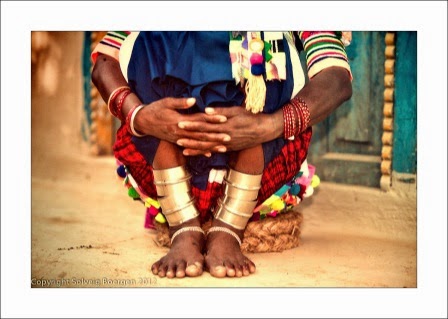
Melange of bright colours in the land of Ranas

Photos: Solveig Boergen
Text: Sanjib Chaudhary

Solveig Boergen travelled to Kanchanpur district of far-western Nepal to shoot the lifestyle of adorable Rana Tharus and the picturesque landscape in October 2012. I have only one word for the images – awesome!

As the sun peeks from the window of the mud house, an old Rana lady is busy preparing meal. The mighty rays illuminate the surrounding and the dark corner of kitchen turns into a portrait painted in ochre.

The lady in her bright blouse sits on a rope cot and makes clay figurines for her grandchildren to play with in the upcoming festival. She draws inspiration from the nature, the tattoos on her arms and the bright colours of her blouse.


Like William Wordsworth's Solitary Reaper, the lady reaps the paddy alone. Her bright costume stands out in the sea of yellow. When her friend joins her, it seems like a competition between the traditional dress she is wearing and the modern dress her mate is adorning. Both the colours burn bright in the yellow field.


It's the marriage season and the ladies show off their ornaments. The silver white looks strikingly beautiful on the bright dress and black shawls.


Like the beautiful patchwork in their dresses, the colours chosen by Ranas form a melange of vivid colours inspired by nature.


Solveig can be reached at solveigboergen@gmail.com