Sunday, February 19, 2012

The Tharu Stick Dancers of Sauraha

Posted on 1 August, 2011 by Jo in www.soundrelated.com
Republished with Jo's permission 


It’s December 30th, 2010 and I’m in the Nepali village of Sauraha, on the border of the Chitwan National Park. Today, after an Elephant ride through the jungles of the park (more on that next time…), we have gathered at the banks of the Rapti River to record the Tharu Stick Dancers.

Having watched the dancers perform a couple of nights before, to a packed out and energetic (read: mic stand kicking) audience at the local cultural centre, I had a fairly good idea of what to expect. I had attempted to record the stick dancers on this night but it was quite fruitless due to the overly echoing room, their use of a PA, audience ‘participation’, etc. But today shall be different, I am prepared!
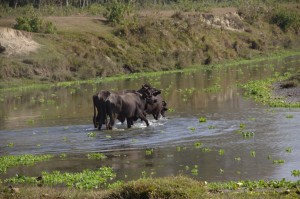
A few of the buffaloes, stopping for a drink.
Arriving at our location I am greeted by the lush green beauty of the jungle and smooth flowing river waters, shining under the bright warm sun. Nearby a group of local villagers are herding a gang of buffalo across the river (see picture above). Not wanting to miss a golden opportunity, and also having a strange love of the sound of water, I grab my Kata pack and walk to the bank of the river. With the pack in ‘sling’ position, I throw on my cans (see picture above, again), pull out my Schoeps MS pair and fire up my Sound Devices 702. Holding the pistol grip of my Rycote Windjammer, I aim the mics towards the buffalo making their way across the river, set my gain level and hit record…

This recording really takes me back to the scene depicted in the first picture above. The width of the stereo image is really amazing, particularly when the man starts calling out to the left. I love the sound of the flowing water and the grunting buffalo crossing the river, shame about the motorbike that comes in at the end though!

…As the herding party moves on up the river I hit stop and make my way back to the main group where the Stick Dancers have arrived. A number of the local villagers appear to have abandoned the buffalo and are hanging back to watch what we’re doing. We never fail to draw an audience it seems!

First recording of the Stick Dancers. 
Looking to where everyone is now setting up, I find that Greg Simmons has decided to record the dancers using a spaced pair of DPA 4041 omnidirectional microphones into his Nagra V location recorder. He has positioned his rather tall mic stand in the centre of the performance space, with the mics raised high and pointing straight down (see picture on right). The dancers will then form a circle around him as they perform.

I decide to take a different approach and set up my MS pair behind the musicians which are accompanying the dancers (see picture on right, again). Aiming the mics back towards the performance space and Greg’s set up, I am hoping to focus in on the Stick Dancers and use the off axis positioning of the musicians to balance their louder level. It doesn’t work very well. The image is horrible and unbalanced, and with the dancers moving around so much, often quite a distance from my mics, their relative level is all over the place. I stop and take a moment to reconsider my mic placement.

After a moments consideration, I pick up my Manfrotto stand and walk it into the centre of the space, placing it next to Greg’s setup. I’ve decided that it will be impossible to record the stick dancers perfectly with my MS pair (the spaced omnis Greg is using are much closer to ideal for this situation), so instead I will focus on the musicians. I extend my mics into the air as high as they will go and angle them down towards the four percussionists. With this placement, the musicians will be the centre of the image and the dancers will move around it but remain the same distance from the mics at all times. The only problem now, will be the dancers moving to the rear of the mics where the null point occurs (I use a cardioid mid microphone in my MS setup), but what can I do, right?!

Things are sounding a lot better with the new mic placement, so I take a seat on the grass next to Greg, shoo away a few small spiders that have decided to climb my jeans, enjoy the sun shining down on me and hit record…


Tharu Stick Dancers of Sauraha from Joseph Dutaillis on Vimeo.
Above is a quick video of the stick dancers in action. The audio here is just off the camera (so it’s average at best) but it gives you an idea of my final mic placement and how the dancers perform. Directly below is the recording I made.

I’m fairly happy with how this recording turned out in the end. The musicians sound great and you get a good sense of movement from the Stick Dancers without it being too distracting or all over the place. Considering the limitations of my MS pair, I don’t think it could have come out much better! As for the performance itself; it is much more of a visual thing (being a dance and all…) so you don’t really get a sense of the awesomeness of it from the audio alone. But I do enjoy the beats and rhythms of it.

One of the local buffalo herders enjoying the afternoon sun.
…As the dancers trail off and the pounding drums come to a silence I hit stop on my recorder and smile to Greg, happy with the recording I have captured. Watching the dance, seated in the very centre of the performance space was very cool, no better way to feel part of the action than actually being in the middle of it. And now it’s time to eat!

Some members of the Holiday Safari Jungle Lodge, where we are staying whilst in Sauraha, have brought us fried rice for lunch. Everyone gathers around quickly and fills their white paper plates with mountains of delicious food. The Stick Dancers and musicians join us as well, indulging in the feast.

A few tasty minutes pass before I shovel the last few morsels of rice down and lay back on the soft green grass to soak in some more of the afternoon sun. Around me the other GE-OS members are indulging themselves in similar activities and chatting with the local Tharu people. Life is pretty sweet.

The Tharu Stick Dancers singing for us.
After a while I sit up to find the Stick Dancers have gathered together with the musicians to perform for us again. But this time, instead of their usual dance, they will be singing some impromptu songs. I quickly jump to my feet and grab my recording rig, unpacking it and throwing on my headphones as I walk over. The dancers have assembled in a rough line, with the musicians in the centre of the group (see picture to the right) and, with limited preparation time, I decide to use the hand held approach I took earlier when recording the buffalo herd. Positioning myself in the centre of the line, roughly 5m back, I point my mics directly towards the percussionists and, not knowing what to expect, hit record…

I love these two recordings. At times they remind me of an American drum line, with the sharp attack and rhythms of the drums. They actually achieve that sound by tying paddle pop sticks to their fingers to hit the drum skin! The call and response style, particularly of the second song below, is also very cool. At times the recording seems to be a tad left heavy, unfortunately, that was due to the louder voices of the singers on the left and some of the boys on the right not singing at all! You can’t do a lot in situations like this without ruining the raw flavour of the whole thing, so best to go with what you have.

…As the last slap of the drums come to an abrupt halt, we all clap and cheer as the performers bow graciously. Everyone is smiling, and why wouldn’t you be! It’s been a “fantastic”1 day. Now to head back to one of the river side resorts for a ‘special’ lassi (more on that next time as well…)!

1 Greg Simmons, every single day of the GE-OS trip, 2010/2011.
- All photos and video courtesy of Greg Simmons, Jarad Avnell and Carlos Rudzats.

To listen to the recordings visit the original post at
http://soundrelated.com/the-tharu-stick-dancers-of-sauraha/


Basanti – the poor man’s auto cart

If you are a movie buff and follow Bollywood, then you must have watched the movie Sholay. The heroine of the movie is a feisty village girl who drives a horse-cart and one of the heroes repeatedly asks her name – “Tumhara nam kya hai Basanti?” (What is your name Basanti?). While Basanti drives the tanga (horse-cart), people in Nepal’s Eastern Terai drive an auto-cart called Basanti.


Airy and spacious journey
The cart is a modified version of a horse-cart or bullock cart. Instead of a horse or bullock pulling the cart, an engine rotates the rear wheels with the help of a belt. The only problem the cart faces is the falling off of the belt which stops the cart. In that case, the helper puts on the belt and pushes the cart to start the engine.

The cart is open and spacious with a tarpaulin overhead to save from rain and sun. It can carry upto 10 passengers at a time and in rush hour some more can join hanging at the back! As the cart contains just a wooden base and a mat on it, the journey is airy, windy, hot, humid or cold depending on the weather – basically it’s an open cart.

Locally made basic structure
When I first travelled in a Basanti, I was fascinated by the idea of the inventor of such a simple vehicle. It has nothing – just three tyres, one engine, a wooden base, few iron rods to hold the tarpaulin overhead and a steering handle – that’s it.

Asking the driver about the machine, I got to know that it was assembled in nearby Sunsari district. The mechanics copied the idea from the bordering town in India. The cart is not expensive, you can buy a second hand cart at a price of one hundred thousand Nepali Rupees (1 USD = 80 Nepali Rupees).

Assembled from stolen bikes
I was curious to know from where the mechanics brought the engine, as it was the only part which could not be made by the local mechanics. The driver had a simple reply – the engines are from the stolen bikes, especially of the brand Pulsar. The engines of stolen bikes are also used in assembling water pumps. The bikes stolen from the urban areas are disassembled and the engines end up in the Terai – to be used in water pumps and of course in Basantis.

Hot during the haats
The Basanti is a much used public vehicle besides tempos and jeeps in the Eastern Terai. It can travel on bumpy roads, gravel roads and even the village streets. In the Terai, at major village junctions, twice a week make-shift markets called haat are organised, where people from nearby villages come to sell and buy the objects of daily need. Especially, during the haat days, the Basantis are full of passengers, most of the times overloaded!

When I asked the driver, why they called the cart Basanti, he just smiled and said, “Go watch the movie Sholay and you will know why we call it Basanti.”


Tuesday, February 14, 2012

They just need a chance to perform

When Nepal won the semi-finals of the ACC U-19 Women’s Cricket Championship, the environment was festive in the small town of Lahan in Nepal. The locals lit lamps throughout the town to celebrate the victory. As the Nepali team won the finals, beating Thailand by six wickets, one of the last girls standing in the crease was Mamta Chaudhary from Lahan. She together with her Captain Rubina Chhetri scored 56 runs to hand the hat trick victory to Nepal. The joy of people from Lahan knew no bounds. The whole town and surrounding was drenched in the victory – made possible by five local girls, Kavita Gautam, Santoshi Chaudhary, Mamta Chaudhary, Anuradha Chaudhary and Saraswati Chaudhary. All five in a way or another contributed throughout the tournament to win the trophy for the third time in a row.


Out of the five, four Tharu girls come from the same village Singarahi near Lahan. Their parents broke the tradition of sending the girls to graze goats. Instead their parents were happy to send their daughters to school and let them play cricket which is still new for the girls in this part of Nepal. In the Terai, till this day the girls are awarded the duty to graze goats while boys are sent to school. In addition, the girls then have to complete all the domestic chores. “With the trend set by these local girls, the situation and thinking of the parents will change,” says Chandra Kishore Kalyan, the President of Tharu Welfare Society Siraha.

Overnight the girls have turned teen idols and national heroes. As reported by Bharat Jarghamagar in the Kathmandu Post daily, Ghuran Chaudhary, the proud father of Saraswati says, “She, not only remained my daughter, but became the daughter of whole country now.” They are famous not only in Singarahi village, Lahan and Siraha district from where they hail, but also throughout Nepal now. Tharus throughout Nepal are sending them compliments and best wishes for their future career.

Their exploits in Kuwait where the tournament was held, have not only inspired many young girls in the area to study and play, but have also influenced the parents to treat their daughters equally and provide them with equal opportunities as their sons.

The four girls have proved that given a chance, they can perform well at all levels. They have broken the shackles of belonging to a society which has always ignored their identity, belonging to a marginalised community that was always kept on margins by the state and being a girl who has always been disregarded by her parents. Kudos to the bravehearts!
Photo courtesy: The Kathmandu Post


Friday, February 10, 2012

Wear tattoos – they will accompany you to the next world

Tattoos have become a fashion statement these days. The multicolour tattoos with modern motifs are a rage among the young generation. Tattoo studios are mushrooming up in urban areas and the tattooing technique is becoming safer, quicker and easier with the advance of technology. Once practised by tribals and indigenous people, and hated by the nobles – tattoos have earned a reputation of beautifying the wearer.


There are records of Polynesians, Samoans, Filipinos, Chinese, Indonesian, Japanese and Northern European tribes wearing tattoos. Researchers have even dug out mummies with tattoos and explored ancient clay figures with tattoos which date back the tradition to prehistoric times.

Tattooing – a popular Tharu culture
Tharus, the indigenous people living in the southern plains of Nepal, have been wearing tattoos since time immemorial. Tattooing was quite popular among Tharu women. They used to get tattoos on their arms, legs and chests to make them more beautiful. The tattoo is called Godna in Tharu language and the tattooers, usually old women, are called Tikaniya.

When I asked an old Tharu lady why she got tattooed all over her body, she had a short and simple reply – when she will die, nobody will accompany her to the next world – but the tattoo will. She also explained that it is a form of permanent jewelry, which can neither be stolen nor erased and that she felt more beautiful with the tattoos on her body.

Once tattooing was compulsory for married Tharu women and they used to get tattooed on their legs prior to marrying, generally in the month of March (the months Falgun – Chaitra in the Bikram Sambat calendar).

Motifs inspired by nature
The tattoos in Tharu culture are inspired by nature. The most common motifs to be tattooed are lines, dots, crosses and several other natural elements. The most common and complicated tattoo that I have observed is that of a peacock, called Mejoor in the Tharu language. While many other motifs are drawn by the experienced tattooers, all of them follow some natural pattern – some modified, some designed to resemble the objects in the vicinity.

Tattooing is painful and gruesome, if done the traditional way. The Tikaniya uses tattooing needles and natural black ink obtained from the soot gathered from a mustard lamp – the process is slow and sometimes the tattoee even faints. The part to be tattooed is rubbed with cow dung and later washed well with water. After drying, mustard oil is applied to make the surface soft. Then begins the painful process of marking the designs and pricking with the tattooing needles.

Declining interest among youngsters
The rigorous and painful process of tattooing was always one of the restraining factors. However, to remain being an active part of the society, the Tharu women in the past used to get tattooed. Having no other means of beautification, tattoos were really popular among the Tharu women.

However, once considered an act of beautification has turned into a vanishing tradition with the modernisation. Now the young generation has many alternatives to enhance their beauty. They don’t need the permanent black motifs all over their bodies to look beautiful anymore.

The influx of people from the hills and North India has influenced the Tharu culture, tradition and rituals. Nowadays the practice of having tattoos of traditional motifs has nearly disappeared. The old experienced Tikaniyas are no more found in the villages nor are there any takers who can steer forward this age long tradition.

Need to modernise the tattooing
The tradition of tattooing is on the verge of vanishing. However, looking at the popularity of modern tattoos among the young generation, there is an imminent need to record the age old motifs used by the Tikaniyas. The motifs need to be modified to suit to the taste of the young generation. The black ink from lamp soot needs to be replaced by multicolour inks. The tattooing needles need to be replaced by the modern tattooing machines. The painful and gruesome practice of tattooing needs to be changed to a pleasurable experience by using the modern methods. However, the Tharus need to stick to the basic designs of the motifs. This will lead to saving the age old tradition being kept alive by few handful Tharu ladies.

(Thanks to the photographers posting the above images in the internet)


Wednesday, February 1, 2012

Walking the Tharu Heritage Trail – Ghodaghodi Lake

Driving westwards from Nepalgunj in the Western Nepal, you will come across the beautiful Ghodaghodi Lake adjacent to the East West Highway. The lake is one of the nine wetlands of international importance in Nepal, enlisted as a Ramsar site. Other eight are Jagadishpur Reservoir, Beeshazari Lake (Twenty Thousand Lake) and Koshi Tappu Wildlife Reserve in the Terai; Gokyo Lake series, Gosaikunda, Rara Lake and Phoksundo Lake in the Himalayas; and recently enlisted Maipokhari in the mid hills.


The lake is of around 10 sq. km and covers three Village Development Committees of the Kailali district. The lake comprises nine different lakes, namely, Ghodaghodi, Ojhuwa, Purbi Ojhuwa, Chaitya, Baishawa, Sunpokhari, Nakhrodi, Budhi Nakhrodi and Ramphal, all of various shapes and sizes separated by marshes. Of the nine-sister lakes, Ghodaghodi is the largest and a concrete dam regulates its outlet.

The myths surrounding Ghodaghodi Lake
Ghodaghodi literally means male and female horse. It is believed that the lake took its name from the clay horses offered by the Tharus to the Goddess at the bank of the lake. One popular belief says that a sage cursed Shiva and Parvati turning them to horses. As the pair circled round the lake, the lake got its name. Another belief is that the lake was too big for a horse to cross the whole distance in a day, so the lake was awarded the name.

On my way to Shuklaphanta Wildlife Reserve, I met Sukhram Das Tharu, the head priest of Ghodaghodi Lake and Tularam from Deukhar. They told me a totally different story of the Ghodaghodi Lake and Temple.

“Many years ago the consort of the Sun God Surya Narayan, Savitri descended to Patal Lok (the world beneath the earth) in disguise of a mare. Following her, the Sun God also went to Patal in search of Savitri. As the Sun went underneath earth, it was dark everywhere. All the Gods then went to Brahma, the Creator for help. Together they went to Vishnu to seek help. Vishnu disappeared while searching them. The Gods in despair then went to Mahadev, the God of Gods. He also disappeared. Finally, they went to Gauri Mata, who meditated and found out about all disappeared Gods. With her might and power, she was able to summon all disappeared Gods near Ghodaghodi Lake.

She then announced that whoever will offer her horses, elephants, tigers made from clay at the Ghodaghodi Lake will get their wishes fulfilled. The Tharus from the area have followed this tradition till today. Chamari Geruwa was the first Tharu priest who could get inside the lake, bring out the offerings and distributed to farmers who used to stay there whole night praying the Goddess. Then the farmers used to take those offerings and establish in their houses. Shitla Geruwa was the second successor, but he was not able to get inside the water. Then Prerna Geruwa from Bakloi succeeded him. All of them were Tharus. Till this day Sukhram Das is continuing the tradition of worshipping the Ghodaghodi Mata, one of the disguises of Gauri.”

You will still find clay horses and tigers offered to the Goddess in the temple. The Tharus gather and worship here in large numbers during the Agahan Panchami and Maghi festivals. They also perform marriage and other rituals here.

Conservation – the need of the moment
Ghodaghodi Lake is an important prime habitat for migrating and resident birds. Around 140 species of different birds can be sighted around this wetland, some birds migrating from as far as Siberia and Mongolia during the winter season. The lake is home to different species of fishes, reptiles, mammals and amphibians. The lake area also houses unique flora and fauna.

People of this area have been depending on the lake and the surrounding area for fishing, irrigation, grazing livestock, collecting fodder, fuelwood, wild fruits and vegetables, and for recreation. Adding to the woes of the lake and surrounding area, hill people from the adjacent hill districts have migrated to this area in search of better opportunities. The large influx of people has resulted into haphazard grazing, unsustainable fishing and illegal logging besides collecting firewood, fodder and wild mushrooms. The rampant use of chemical fertilisers and pesticides has led to the percolation of chemicals into the lake waters posing threats to the biodiversity. The lake also faces the potential danger of eutrophication.

Looking at the possible perils to the lake, it is the need of the moment to join hands and save the Ghodaghodi Lake and its associated lakes and ponds - not only to save the biodiversity of the area but also to save one of the pearls in the Tharu Heritage Trail. And of course, the age old Tharu tradition of offering clay horses to the Goddess Ghodaghodi.


Wednesday, January 25, 2012

Gorha – the dung cake and its significance

Take some cow dung, some rice husk, some straw and a bucket of water. Knead the cow dung (you can add buffalo dung to it as well) properly with both hands. If the dung is hard, put some water and mix it well. Make a long cylindrical structure out of the mixture measuring to an arm’s length and open it in the middle like you open pods of a pea. Put a handful of straw in between and close the structure, pour a handful of rice husk so that the dung mixture doesn’t stick on your palms and flatten the structure. Make similar structure and arrange them lengthwise in a row, around four to five in a straight line. Now you are ready with your first lot of cow dung cakes, better called gorha in the Terai. Next day, the dung cakes get a little bit harder, hard enough to hold the weight of next round of four to five cakes above them. Then you can pile up another round of fresh cakes on it column-wise if you arranged the ground set row-wise. Continue the same the following day and the days following after till your pile of cakes gain a height of around three feet. After a months’ soaking in sun, the cakes get ready to be used.

Dung cake varieties
While gorha is the regular dung cake, chipri is the smaller version of the dung cakes. Usually ones who don’t have cattle of their own collect the dung from grazing fields and make small round patches of dung cakes by sticking them to walls for drying. Once dried, the cakes are collected and stored in a dry place for future use. Here, straw is not used and even the rice husk is avoided.

The dried dung collected from the grazing field is simply called goitha. It is ready to use for cooking.

The bigger form of the dung cakes is gorhaini, which is similar to the gorha but is a longer variant measuring even upto five feet. Instead of putting straw in the middle of the cake, jute twigs are used. Rice husk is used as in the gorha. They are not piled as gorha, but are left standing by a wall or fence to dry.

Manifold benefits
The dung cakes are used extensively in cooking along with the timber, hay, dry leaves, bamboo culms and dry twigs in the Terai. In comparison to the other fuelwood, the dung cakes burn longer. That’s why the dung cakes are mixed with other fuelwood while cooking to save the timber. The calorific value of the dung cakes is lower, but as it burns slower, it is preferred for heating rooms in winter and cooking.

The proponents of modern technologies claim that dung cakes produce lots of smoke and ash as residue. The one and only way to minimise the smoke and ash and get more heat is to dry the dung cakes well before burning.

Not long ago, the dung cakes were used to save the fire – and again light when needed, in absence of matchsticks. Thanks to the technology and easily available cheap matchsticks, the dung cakes are no more used for the purpose. However, the poorest ones in rural villages still rely on the dung cakes to ignite fire.

Besides providing more heat and burning for a longer period of time, the dung cakes have another advantage – they work as mosquito repellents as well. The mosquitoes keep away when the dung cakes are burnt.

The ash from the burnt dung cakes are put in the fields as manure. It is also used to wash the utensils. The ash works as a perfect cleaner, replacing the scrubber and washing powder.

I am not sure, how good it is for cleaning teeth, but you can still find few old people in the rural villages who brush their teeth with the ash from the dung cakes and you will be shocked to see their teeth, sparkling like pearls.


Dwindling use
The dung cakes, in spite of the manifold benefits, are accused of causing respiratory diseases. Figures show that the children and women are the worst sufferers and the cause being smoke in the kitchen. However, the smoke can easily be managed with the advent of improved cook stoves. The cook stoves in the rural villages need to be modified to save the women and children from the pulmonary diseases, instead of stopping the use of dung cakes for cooking.

Modern technologies like biogas are slowly replacing the dung cakes. Now the dung is well mixed and hauled in the digester which produces the methane gas and slurry as the by-product. The gas is used for smoke-free cooking and the slurry can be used as a bio-fertiliser in the fields.

As the cooking is hassle-free, smoke free and even the utensils are cleaner, more and more people are opting for the biogas plants. However, as the initial set-up of the biogas digester is expensive, the poor populace has not been able to take the benefits of the modern technology.

In spite of the dwindling use of dung cakes and introduction of incense sticks, you will still find rural people using the chopped pinewood and dung cakes for the daily worship. It is still considered to be more pure form of offering to the Gods. Especially, the cow dung cakes are preferred to other fuelwood and timber while performing the pooja or worship.


Bridge between two major Tharu festivals/rituals
The dung cakes are special in Tharu culture. Two major festivals/rituals celebrated by the Tharus are linked by the dung cake chipri. Tharus make godaha/godahaini (of human form) from the cow dung and leave it for the night in the gahli, the cowshed on the fourth day (Govardhan Pooja) of the Hindu festival Deepawali/Tihar. The next day, the godaha/godahaini is made into a chipri, dried and stored in a safe place.

The same chipri is used to light fire and cook the first grain harvested from the field and offered to the home deity. The ritual is called Neman. It is celebrated in honour of the new harvest and is celebrated in the month of November. Only after celebrating Neman, the Tharus consume the newly harvested grain.

Due to the cultural significance of dung cakes, they will never vanish from the scene though with the modernisation, their use is decreasing. With the declining trend, we at least need to know how to make dung cakes, not just to keep our traditions alive but also to feel proud about it. The bottomline is, gobar, the cow dung is not only holy but also has healing properties!

Wednesday, December 21, 2011

Sidhara – the colocasia concoction

Can you imagine a concoction of colocasia stem, turmeric, garlic, dried fishes, radish and green chillies? The aroma is pungent, the taste is bitter and still it is one of the delicacies eaten by the Terai dwellers especially indigenous peoples like the Tharus, Danuwars, Musahars and others. Sidhara, as the locals call it, is a dried cake of dried fishes, colocasia stem and turmeric. Radish, green chillies and garlic are added to the cake to enhance the taste. (I have used the term colocasia referring the genus rather than using the particular taro plant, Colocasia esculenta – as species other than esculenta are also used in preparing sidhara.)

Fishes everywhere
During the rainy season, when the fields are awash with rainwater and there is no dearth of water, there are fishes everywhere – of all sizes and all tastes. The people in Terai are seen busy catching fishes through all sorts of traditional equipment – fishing rods, fishing nets, chachh, dhasha and konia which are traditional fish traps laid on the flowing waters between two adjacent fields.

The dhasha is the most popular equipment to trap fishes between the flowing waters in paddy fields. It is made of bamboo culms or jute twigs woven together and as the water flows from one field to another field the fishes are trapped in it.

Indigenous ingredients
The fresh fishes are eaten and the remaining are dried to make sukthi, dried fish to be used during the winter and other seasons. The dried fishes and dried vegetables are saved for times when it is difficult to get fresh fish and vegetables.

The Dedhna and Ponthi varieties are preferred to prepare sidhara. Both the varieties are found in abundance in the paddy fields and public water sources. The dedhnas are one of the smallest varieties of edible fishes and can be eaten with its tender bones. They vary in sizes between half an inch to one and half inch in length (so the name Dedhna – meaning one and half). The second variety ponthi is a little bit bigger and wider than the Dedhna and it too can be eaten with its bones.

Colocasia is found in abundance in the swampy places, ditches and nowadays even cultivated in the kitchen gardens. The leaves are eaten separately and the stems are used either for the sidhara or dried after being cut into small pieces. The dried colocasia is eaten in the winter and rainy seasons when there is dearth of fresh vegetables.

The dried fishes, together with the colocasia stem and turmeric powder is ground and made into small cakes. The cakes are left to dry in the sun for 10-15 days and after that it is stored in a dry place for future use.

Food value
Dried fish is very rich source of protein, containing 80-85% protein. Researches have shown that some compounds in turmeric have anti-fungal and anti-bacterial properties. Besides being used as a colouring agent in key dishes, it enhances the taste and has medicinal properties as well. Colocasia is eaten widely in the Indian subcontinent. The extra additions – green chillies, radish and garlic enhance the taste, reduce the odour and are good for health.

Pungent aroma and bitter taste
The pungent aroma of sidhara is an open invitation to the neighbours to come and join the delicious dish. When the sidhara cake is crushed and fried in mustard oil before adding other ingredients, the acrid smell spreads in the surrounding and the word spreads that sidhara is being cooked.

Green chillies, radish, garlic and spices are added to enhance the taste. The mixture is cooked as a curry and is bitter in taste but delicious when eaten with beaten or puffed rice.

Next time you visit the Terai, ask for the colocasia concoction and I am sure your taste buds will be delighted to savour the traditional food!